Category: best meanings

  • Responsibility Meaning Explained Simply for Smart Readers

    Responsibility Meaning Explained Simply for Smart Readers

    Responsibility meaning shows up everywhere in job descriptions, parenting advice, legal documents, and everyday conversations.

    It also includes being accountable for your behavior, respecting others, managing time effectively, and making ethical choices in daily life.

    Responsibility can apply to family roles, workplace duties, legal obligations, financial decisions, and social commitments.

    As people grow older, they often take on greater responsibilities that require discipline, honesty, and reliability.

    But it’s more than a dictionary word: responsibility is a core idea that shapes how people behave, how organizations function, and how societies stay stable.

    This guide (updated for 2026) explains what responsibility means, where it comes from, common types, real life examples, mistakes people make, and practical tips to act more responsibly.


    What Does Responsibility Mean? (Definition & Origin)

    Simple definition

    Responsibility is the state or fact of being accountable for something, having a duty to deal with it, or being the cause of an outcome. It combines obligation, authority, and answerability.

    • Obligation — you’re expected or required to do something.
    • Authority — you often have the power or tools to act.
    • Accountability — you must explain or accept consequences for the result.

    Word origin (short)

    The word comes from Latin roots meaning “to respond.” Over centuries it evolved into the idea that people must respond to duties and consequences.


    Different Types of Responsibility

    Responsibility appears in many shapes. Here are the most common ones:

    1. Moral Responsibility

    • Linked to ethics and conscience.
    • Example: Feeling responsible for apologizing after hurting a friend.

    2. Legal Responsibility

    • Imposed by laws and regulations.
    • Example: A driver’s legal responsibility to follow traffic rules.

    3. Professional/Workplace Responsibility

    • Duties tied to a job role or contract.
    • Example: A project manager is responsible for meeting delivery deadlines.

    4. Personal Responsibility

    • Daily habits and self-care—how you manage your life.
    • Example: Paying bills on time, keeping appointments.

    5. Collective or Social Responsibility

    • Duties shared by groups, companies, or societies.
    • Example: Corporations’ responsibility toward environmental sustainability.

    Why Responsibility Matters

    • Trust & Reliability: Responsible people and organizations are trusted.
    • Order & Safety: Rules work only when people accept responsibility.
    • Growth & Learning: Owning outcomes (good or bad) helps people improve.
    • Social cohesion: Shared responsibilities (like taxes, civic duties) keep societies functioning.

    Responsibility in Practice — Real-Life Examples

    • Parenting: Parents are responsible for a child’s care, education, and safety.
    • Work: Your job description lists responsibilities; meeting them affects team success.
    • School: Students are responsible for attending class and turning in assignments.
    • Civic: Voting, jury duty, obeying laws—forms of civic responsibility.
    • Environment: Choosing reusable products is a small act of social responsibility.

    How Responsibility Differs from Blame or Guilt

    • Responsibility is about duty and accountability — what must be done or who must act.
    • Blame assigns fault for a bad outcome (often emotionally charged).
    • Guilt is an internal feeling when you believe you did wrong.

    You can accept responsibility without falling into unhealthy guilt. Responsible action focuses on solutions and learning.


    Common Mistakes & Misunderstandings

    • Mistake 1 — Confusing responsibility with control.
      You can be responsible for outcomes even if you don’t fully control every factor.
    • Mistake 2 — Avoiding responsibility to dodge consequences.
      Deflecting responsibility erodes trust and damages relationships.
    • Mistake 3 — Over-responsibility (taking on too much).
      Saying “yes” to everything can lead to burnout. Responsibility should be shared where appropriate.

    How to Be More Responsible — Practical Tips

    1. Clarify expectations. Ask “What am I responsible for?” — written or verbal clarity prevents confusion.
    2. Break it down. Turn big responsibilities into small, actionable steps.
    3. Own your outcomes. If something goes wrong, assess honestly and outline corrective steps.
    4. Communicate early. Warn stakeholders as soon as you see risks.
    5. Delegate when appropriate. Responsibility doesn’t mean doing everything yourself.
    6. Set boundaries. Learn to say no to avoid overcommitting.
    7. Reflect and improve. Regularly review what worked and what didn’t.

    Responsibility at Work — a Quick Checklist (for managers & teammates)

    • Are roles clearly defined?
    • Are deadlines realistic and resourced?
    • Is accountability tracked (reports, standups, KPIs)?
    • Are mistakes handled constructively—blame vs. learning?
    • Is responsibility shared or siloed in risky ways?

    Related Concepts & Keywords (SEO-friendly suggestions)

    • Accountability meaning
    • Duty vs responsibility
    • Personal responsibility examples
    • Collective responsibility
    • Corporate social responsibility (CSR)

    Internal linking idea: Link to articles like “Accountability vs Responsibility,” “Corporate Social Responsibility Explained,” or “How to Build Accountability at Work.”


    Responsibility Meaning in One Sentence

    Responsibility is the obligation to act (or to answer for actions) and to accept the consequences of those actions—ethically, legally, or socially.

    FAQs

    1. What is the meaning of responsibility?
    Responsibility means being accountable for your actions, decisions, and duties.

    2. Why is responsibility important?
    Responsibility builds trust, improves relationships, and helps people achieve personal and professional success.

    3. What is an example of responsibility?
    Completing your work on time, keeping promises, and accepting the results of your actions are examples of responsibility.

    4. Is responsibility the same as accountability?
    No, responsibility is the duty to act, while accountability means answering for the outcome of those actions.

    5. How can someone become more responsible?
    You can become more responsible by staying organized, keeping commitments, and learning from your mistakes.

    6. What does responsibility mean in everyday life?
    In everyday life, responsibility means fulfilling your obligations at home, school, work, and in your community.


    Conclusion!

    Responsibility is a practical and moral compass that keeps relationships, workplaces, and societies working.

    In 2026, as work becomes more distributed and social impact expectations grow, responsibility both individual and collective matters more than ever.

    By learning the true responsibility meaning, you can make better decisions, earn respect from others, and develop valuable life skills that contribute to long term success.

    As you practice responsibility consistently, it becomes a habit that improves both your personal growth and professional achievements.

    Own what you can, share what you should, and learn from every outcome.
  • Influencer Meaning Explained for Social Media Fanatics

    Influencer Meaning Explained for Social Media Fanatics

    You’ve probably heard the term influencer everywhere on Instagram, TikTok, YouTube, and even in business news.

    But what does it actually mean?

    Understanding the influencer meaning is key for anyone navigating social media, marketing, or online culture today.

    In simple terms, an influencer is a person who has built a loyal audience and has the ability to influence the opinions, decisions, or purchasing behavior of others through the content they create.

    Unlike traditional celebrities, influencers often gain popularity by consistently sharing valuable, entertaining, or educational content within a specific niche, such as fashion, beauty, fitness, gaming, travel, technology, food, or personal finance.

    This guide is fully updated for 2026, human-friendly, and breaks down what an influencer is, the types, their role, real-life examples, and how they impact society.


    What Does Influencer Mean? (Definition & Origin)

    Simple Definition

    An influencer is a person who affects the opinions, behavior, or purchasing decisions of others, usually through social media, blogs, or other online platforms.

    Key points:

    • Influencers have authority, credibility, or popularity in a particular niche.
    • They can promote products, trends, ideas, or lifestyles.
    • Their influence is measured through audience engagement (likes, shares, comments, views).

    Origin of the Word

    • Comes from the verb “to influence”, which means to sway or affect someone’s thoughts, feelings, or actions.
    • The term “social media influencer” became popular in the 2010s as platforms like Instagram, YouTube, and TikTok grew.

    In short: An influencer is someone who can shape opinions and trends because people listen to them online.


    Types of Influencers

    Influencers come in all shapes and sizes, depending on audience and niche:

    1. Mega-Influencers

    • Millions of followers, usually celebrities or public figures.
    • Example: Kim Kardashian, Cristiano Ronaldo.

    2. Macro-Influencers

    • 100,000–1 million followers, niche experts or popular content creators.
    • Example: Travel bloggers, fitness coaches.

    3. Micro-Influencers

    • 10,000–100,000 followers, smaller but highly engaged audiences.
    • Example: Local chefs, DIY creators, lifestyle vloggers.

    4. Nano-Influencers

    • 1,000–10,000 followers, very close-knit and trusted community.
    • Example: Local mom bloggers, hobbyist reviewers.

    Influencer Meaning in Social Media

    Influencers are primarily associated with social media platforms, where they:

    • Share content that educates, entertains, or inspires.
    • Promote brands through posts, stories, reels, or videos.
    • Create trends in fashion, tech, wellness, or entertainment.

    Example:

    A fitness influencer posts daily workout routines on Instagram, inspiring thousands to exercise and follow their lifestyle.


    Influencer in Marketing

    Brands collaborate with influencers to reach audiences authentically:

    • Sponsored posts: Influencer shares a product in exchange for payment.
    • Affiliate marketing: They earn a commission for products sold via their link.
    • Brand ambassador: Long-term partnership, representing a company’s image.

    Why brands use influencers:

    • Builds trust quickly
    • Reaches targeted audiences
    • Creates content that feels organic

    Influencer Meaning in Real Life

    Being an influencer isn’t just about followers—it’s about impact and trust.

    • A parenting influencer may advise thousands of mothers on childcare.
    • A tech influencer can guide people on the best gadgets to buy.
    • A social activist influencer can raise awareness for environmental or social causes.

    Influence is measured not just by numbers, but by how much your audience acts on your guidance or advice.


    Common Misunderstandings About Influencers

    Misunderstanding #1: “Influencers Are Just Famous for No Reason”

    Reality: Many influencers provide value, expertise, or entertainment, building trust and engagement over time.

    Misunderstanding #2: “Influencer Marketing is Only for Big Brands”

    Reality: Small businesses, local shops, and nonprofits also benefit from micro and nano influencers.

    Misunderstanding #3: “Influencers Always Promote Products”

    Reality: Many share advice, awareness campaigns, or personal experiences, not just commercial promotions.


    Related Terms and Concepts

    • Social Media Marketing (SMM) – Using influencers to promote brands online
    • Content Creator – Someone who makes online content, may or may not monetize
    • Brand Ambassador – Influencer in a long-term partnership
    • Engagement Rate – How actively followers interact with posts
    • Viral Marketing – Content that spreads rapidly online

    Internal linking idea: Articles like “Content Creator vs Influencer Explained” or “Micro vs Macro Influencers” complement this post.


    Influencer Meaning in One Sentence

    An influencer is a person who shapes the opinions, behaviors, or decisions of others through credibility, content, and online presence.

    FAQs

    1. What does influencer mean?
    An influencer is a person who can affect others’ opinions or buying decisions through their online presence and content.

    2. What is the meaning of influencer in social media?
    On social media, an influencer is someone with an engaged audience who promotes ideas, products, or services.

    3. Who can be called an influencer?
    Anyone who consistently creates valuable content and builds trust with a specific audience can be called an influencer.

    4. What is the difference between an influencer and a content creator?
    A content creator focuses on producing content, while an influencer primarily influences audience behavior and purchasing decisions.

    5. Why are influencers important in digital marketing?
    Influencers help brands reach targeted audiences, increase trust, and improve engagement through authentic recommendations.

    6. Can anyone become an influencer?
    Yes, with consistent, high-quality content, audience engagement, and a clear niche, almost anyone can become an influencer.


    Conclusion!

    Influencers are powerful voices in today’s digital culture, shaping trends, opinions, and consumer behavior.

    Whether mega, micro, or nano, their ability to connect authentically with audiences defines their impact.

    As influencer marketing continues to grow, recognizing the different types of influencers and their impact will help you make informed decisions as a consumer, brand, or aspiring creator.

    In 2026, the influencer world continues evolving with AI tools, live commerce, and immersive content making influence more measurable and impactful than ever.

  • Gibbous Meaning Explained The Surprising Way You’ll Love

    Gibbous Meaning Explained The Surprising Way You’ll Love

    If you’ve ever looked up at the night sky and someone said, “It’s a gibbous moon tonight,” you might have wondered: what does gibbous mean?

    The gibbous meaning is simple yet fascinating.

    A gibbous shape refers to something that is more than half illuminated but not completely full.

    In astronomy, the term is most commonly used to describe the Moon during the period when it appears larger than a half moon but has not yet reached the full moon or after the full moon when it begins to shrink while still remaining mostly illuminated.

    Understanding the gibbous meaning helps you read the phases of the moon, enjoy stargazing, and even understand astronomy references in culture, literature, or social media.

    This guide is fully updated for 2026, written in human-friendly language, and provides examples, explanations, and practical tips for recognizing gibbous moons.


    What Does Gibbous Mean? (Definition & Origin)

    Simple Definition

    Gibbous describes the shape of the moon when more than half of it is illuminated but it’s not full yet.

    • The term is most commonly used in astronomy.
    • A gibbous moon is between a half moon and a full moon.

    In short: A gibbous moon looks bigger than a half moon but isn’t fully round like a full moon.


    Origin of the Word

    • The word gibbous comes from Latin gibbus, meaning hump or swelling.
    • It has been used in English since the 14th century to describe swollen or bulging shapes, and in astronomy, it describes the “bulging” shape of the moon.

    Types of Gibbous Moon

    There are two types of gibbous moons:

    1. Waxing Gibbous

    • Occurs after the first quarter moon and before the full moon.
    • The illuminated part is increasing.
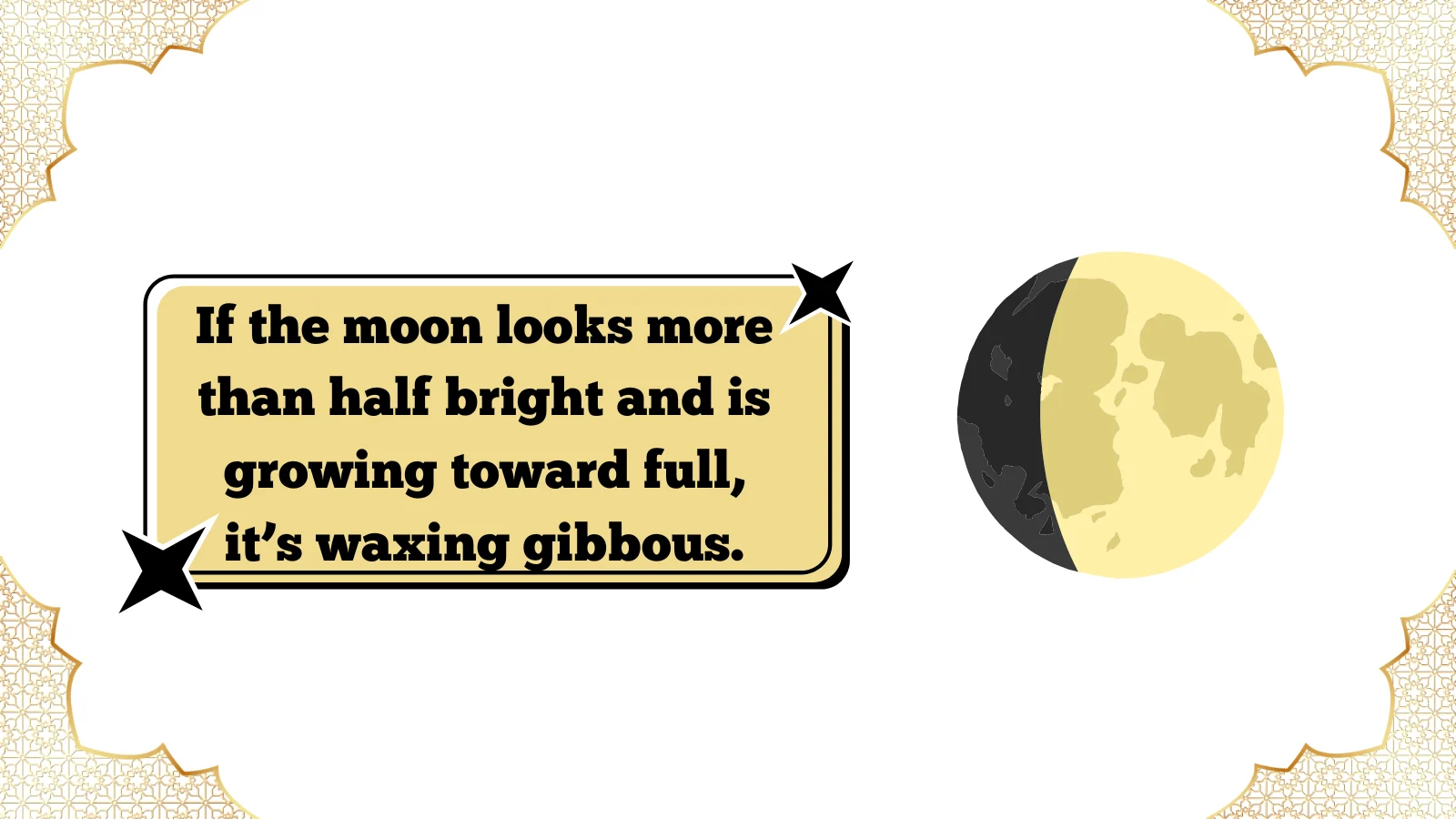
    • Example: If the moon looks more than half bright and is growing toward full, it’s waxing gibbous.

    2. Waning Gibbous

    • Occurs after the full moon and before the last quarter moon.
    • The illuminated part is decreasing.
    • Example: If the moon looks more than half bright but shrinking toward half, it’s waning gibbous.

    Tip: Waxing = growing, Waning = shrinking


    How to Identify a Gibbous Moon

    • More than half of the moon is lit
    • Less than a full moon
    • Curved shape – bulging but not round
    • Can be observed with the naked eye

    Example in Nature:

    Tonight’s moon is waxing gibbous, glowing bright in the evening sky before it becomes full on Friday.


    Gibbous Moon Meaning in Culture

    • Literature & Poetry: Often symbolizes growth, mystery, or change.
    • Folklore: Some cultures associate the gibbous moon with preparation, reflection, or mystical energy.
    • Astrology: In some beliefs, gibbous moon phases are times to focus on refinement and progress.

    Common Misunderstandings About Gibbous

    1. “Gibbous means full moon.”
      Reality: A gibbous moon is not yet full or slightly past full.
    2. “Gibbous refers to size of the moon.”
      Reality: The moon’s size doesn’t change, only the visible illuminated portion.
    3. “You can see gibbous moons during the day.”
      Reality: While technically visible during daylight sometimes, gibbous moons are usually most noticeable at night.

    Related Terms

    • Crescent Moon – Less than half illuminated
    • Quarter Moon – Half illuminated
    • Full Moon – Fully illuminated
    • Waxing – Growing toward full
    • Waning – Shrinking toward new moon

    Internal linking idea: Link to “Moon Phases Explained” or “Crescent vs Gibbous vs Full Moon.”


    Gibbous Meaning in One Sentence

    Gibbous refers to a moon phase where more than half is illuminated but it is not yet or just past full.

    FAQs

    1. What does gibbous mean?
    A gibbous shape is more than half full or rounded, most commonly used to describe the Moon.

    2. What is a gibbous Moon?
    A gibbous Moon is the lunar phase when more than half of the Moon is illuminated but it is not yet full.

    3. What is the difference between waxing and waning gibbous?
    A waxing gibbous is growing toward a full Moon, while a waning gibbous is shrinking after the full Moon.

    4. Why is it called a gibbous Moon?
    The term comes from the Latin word gibbosus, meaning “humpbacked” or “rounded.”

    5. How long does the gibbous Moon phase last?
    The gibbous phase lasts for several days before and after the full Moon during each lunar cycle.

    6. Is the gibbous Moon visible during the day?
    Yes, depending on the time of month, a gibbous Moon can often be seen in the daytime as well as at night.


    Conclusion!

    The gibbous meaning is simple yet fascinating for anyone interested in astronomy, culture, or stargazing.

    By observing the gibbous moon, you can track the lunar cycle, connect with folklore, or simply enjoy the beauty of the night sky.

    Observing it helps us appreciate astronomy, natural rhythms, and even cultural symbolism connected to the moon.

    From a practical perspective, knowing what a gibbous moon looks like can enhance stargazing, photography, and moon tracking, while also giving context to references in literature, astrology, and folklore.

  • Baller Meaning Simple Breakdown Funny Truth Revealed

    Baller Meaning Simple Breakdown Funny Truth Revealed

    You’ve probably heard someone say, “That’s baller,” or “He’s a real baller,” especially online or in pop culture.

    But what does baller actually mean?

    The baller meaning has evolved over time from sports roots to modern slang that signals success, confidence, and luxury.

    This guide is updated for 2026, written in clear, human friendly language, and explains how baller is used today in texting, social media, music, and everyday conversations.

    In today’s digital era, slang terms like “baller” evolve quickly, especially on platforms like TikTok, Instagram, and Snapchat.

    Therefore, understanding the true “baller meaning” helps users communicate more effectively and avoid confusion in online conversations.


    What Does Baller Mean? (Definition & Origin)

    Simple Definition

    Baller is a slang term used to describe someone who is successful, confident, wealthy, stylish, or impressive, often living a high-status or “luxury” lifestyle.

    In casual terms: A baller is someone who’s winning at life—or at least looks like it.

    Origin of the Word

    • Originally comes from basketball slang, where a baller was a highly skilled basketball player.
    • Over time, hip-hop culture and social media expanded the meaning to include wealth, hustle, confidence, and flashy success.

    Baller Meaning in Modern Slang

    Today, baller goes far beyond sports.

    Common slang meanings:

    • Someone who is rich or financially successful
    • Someone who lives a luxury lifestyle
    • Someone who is cool, confident, or impressive
    • Something that is top-tier or high quality

    Examples:

    • “She bought a house at 25—total baller move.”
    • “That vacation setup is baller 🔥”
    • “He’s not famous, but he lives like a baller.”

    Baller Meaning in Sports

    In sports, especially basketball:

    • A baller is someone who is exceptionally good at playing ball
    • Often implies confidence, skill, and dominance on the court

    Example:

    “Did you see his handles? That guy’s a straight baller.”

    This usage is still common and respected in athletic circles.


    How to Use Baller in Texts and Chats

    Baller is informal and best used in casual conversations.

    Correct usage:

    • “That outfit is baller 😎”
    • “You paid everyone’s dinner? Baller.”
    • “New car already? That’s baller status.”

    Not ideal for:

    • Formal emails
    • Academic writing
    • Professional reports

    Baller vs Similar Slang Words

    Here’s how baller compares to related slang:

    • Boss – Someone in control or leadership
    • Flex – Showing off success or possessions
    • Rich – Focuses only on money
    • Drip – Stylish appearance
    • GOAT – Best of all time in a field

    👉 Baller combines success + confidence + lifestyle.


    Common Misunderstandings About Baller

    ❌ “Baller only means basketball player”

    ✔️ Not anymore. It now commonly means successful or impressive in general life.

    ❌ “You must be rich to be a baller”

    ✔️ Not necessarily. Someone can be a baller through confidence, bold choices, or smart moves.

    ❌ “Baller is always serious”

    ✔️ It’s often used playfully or humorously.


    Related Slang Terms (Internal Linking Ideas)

    • Hustle meaning
    • Flex meaning in slang
    • Drip slang meaning
    • GOAT slang meaning
    • Savage slang meaning

    Baller Meaning in One Sentence

    Baller is a slang term used to describe someone or something that represents success, confidence, luxury, or impressive skill.

    FAQs

    1. What does “baller” mean in slang?
    “Baller” is slang for someone who is rich, successful, or lives a luxurious and confident lifestyle.

    2. Is “baller” a positive or negative word?
    It is mostly a positive slang term used to praise someone’s wealth, success, or impressive style.

    3. Where did the word “baller” come from?
    It originally comes from basketball culture, referring to skilled players who “ball” on the court.

    4. Can “baller” be used in everyday conversation?
    Yes, it is commonly used in casual speech and online chats to describe someone impressive or stylish.

    5. What is an example of using “baller” in a sentence?
    “He bought a new sports car—he’s such a baller now.”

    6. Does “baller” only refer to rich people?
    No, it can also refer to someone who is confident, successful, or highly skilled, not just wealthy.


    Conclusion!

    The baller meaning has grown from basketball courts to social media captions, music lyrics, and everyday conversations.

    In 2026, calling someone a baller isn’t just about money it’s about confidence, bold moves, and living life on your own terms.

    Whether you’re talking about a person, a purchase, or a moment, baller is a modern way to say: “That’s impressive.”

    By knowing its context and usage, readers can better interpret online chats, memes, and pop culture references.

  • Hijack Meaning Viral Truths That Crack Up Fans

    Hijack Meaning Viral Truths That Crack Up Fans

    The word hijack often sounds serious and for good reason.

    You’ll hear it in news reports, tech discussions, and even casual conversations online.

    But the hijack meaning changes slightly depending on context.

    In general usage, hijack originally referred to the illegal seizure of vehicles such as airplanes, cars, or ships by criminals or terrorists.

    Over time, the word has evolved and is now commonly used in cybersecurity to describe situations where hackers gain unauthorized control over websites, accounts, or systems.

    In social media language, “hijack” can also mean taking over a conversation or trending topic, often in a humorous or strategic way.

    This guide explains what hijack means, where it comes from, how it’s used today, and common misunderstandings clearly and simply.


    What Does Hijack Mean? (Definition & Origin)

    Simple Definition

    Hijack means to take control of something forcefully, illegally, or without permission.

    In plain terms: hijacking is taking over something that isn’t yours—by force, threat, or manipulation.

    Word Origin

    • First widely used in the early 20th century
    • Originally referred to stealing alcohol shipments during Prohibition
    • Later expanded to include planes, vehicles, systems, and even conversations

    Hijack Meaning in Different Contexts

    1. Hijack in Crime & Security

    This is the most serious and traditional meaning.

    • Aircraft hijacking: Taking control of a plane illegally
    • Vehicle hijacking (carjacking): Stealing a vehicle using force or threats

    Example:

    “The plane was hijacked shortly after takeoff.”


    2. Hijack Meaning in Technology

    In tech and cybersecurity, hijack is commonly used metaphorically.

    • Account hijacking: When someone gains unauthorized access to your account
    • Browser hijacking: Malware changes your browser settings
    • Session hijacking: Stealing user session data

    Example:

    “My social media account was hijacked after clicking a suspicious link.”


    3. Hijack in Conversations & Social Media

    In informal language, hijack can mean taking over a discussion.

    • Used casually (not criminal)
    • Often slightly negative or joking

    Example:

    “Sorry to hijack the thread, but I have a question.”


    4. Hijack in Business or Media

    • Brand hijacking: Misusing a brand’s name or identity
    • Topic hijacking: Shifting attention away from the original subject

    Example:

    “The campaign message was hijacked by online controversy.”


    How to Use Hijack Correctly

    Appropriate Uses:

    • News and crime reporting
    • Cybersecurity discussions
    • Casual apologies in conversations

    Be Careful When:

    • Using it jokingly around sensitive topics
    • Writing formal documents without clarity

    Common Mistakes & Misunderstandings

    “Hijack only means plane-related crimes”
    ✔️ It applies to vehicles, accounts, conversations, and systems

    “Hijack is always violent”
    ✔️ Not always—tech and conversational uses are non-physical

    “Hijack and kidnap mean the same thing”
    ✔️ Kidnap targets people; hijack targets control of things or systems


    Related Words & Terms

    • Carjack – Steal a car by force
    • Hack – Break into systems (not always hijacking)
    • Seize – Take control (formal term)
    • Takeover – Can be hostile or neutral

    Internal linking idea:

    • “Account Hijacking Explained”
    • “Cybersecurity Terms You Should Know”

    Hijack Meaning in One Sentence

    Hijack means to unlawfully or forcefully take control of something—physically, digitally, or metaphorically.

    FAQs

    1. What is the meaning of hijack?
    Hijack means to illegally take control of a vehicle, aircraft, or system using force or threat.

    2. What does hijack mean in simple words?
    In simple words, hijack means to steal control of something, especially transportation or digital accounts.

    3. What is hijack meaning in digital security?
    In digital security, hijack means unauthorized access or control over accounts, websites, or sessions.

    4. What is browser hijacking meaning?
    Browser hijacking is when malware changes your browser settings without permission to redirect traffic or ads.

    5. What is social media hijacking meaning?
    Social media hijacking means someone illegally takes control of your social media account and uses it.

    6. What is airline hijack meaning?
    Airline hijack means unlawfully taking control of an aircraft while it is in flight using threats or force.


    Conclusion!

    The hijack meaning has expanded far beyond planes and crime headlines.

    Today, it applies just as much to cybersecurity threats, online discussions, and media narratives.

    However, in modern usage, especially in online discussions and social media, it is also commonly used to describe taking control of a conversation, account, hashtag, or even attention in a way that redirects it from its original purpose.

    This dual meaning makes it important for readers, students, and content creators to clearly understand the context in which the term is used.

    Understanding how the word changes with context helps you use it accurately and recognize when control is being taken where it shouldn’t be.

  • Back Order Meaning Explained Simple and Powerful

    Back Order Meaning Explained Simple and Powerful

    If you’ve ever ordered something online and seen the message “This item is on back order”, you’re not alone and you’re definitely not the only one confused by it.

    The phrase back order shows up everywhere today: online stores, customer support chats, emails, forums, and even casual texts.

    Understanding the back order meaning can save you time, money, and a lot of frustration.

    In fast moving digital conversations, people expect quick answers.

    That’s why knowing what back order really means and how it’s used in modern chat and online communication is more important than ever.


    What Does Back Order Mean? (Definition & Origin)

    Simple Definition of Back Order

    At its core, back order means:

    A product is currently out of stock, but you can still order it and receive it later once it’s available again.

    In other words:

    • The seller doesn’t have the item right now
    • Your order is saved
    • The item will ship later, when inventory is restocked

    Back Order Meaning in Plain English

    Think of it like reserving your spot in line.

    You’re basically telling the seller:

    “I want this item. I’m okay waiting until you get more.”

    Where Did the Term “Back Order” Come From?

    The term back order originated in traditional retail and supply chain management—long before texting and online shopping existed.

    • Back = delayed or pending
    • Order = a purchase request

    Retailers used it internally to track items customers wanted but weren’t currently available. Over time, as eCommerce grew, the term became customer-facing and started appearing in:

    • Online product pages
    • Order confirmation emails
    • Live chat messages
    • Text notifications

    Now, it’s part of everyday digital language.


    What Does Back Order Mean in Texts or Chat?

    Back Order Meaning in Modern Messaging

    In texts or chats, back order is usually shorthand for explaining a delay.

    Examples:

    • Customer support chats
    • Marketplace DMs
    • Business texts
    • Online forums

    It often appears in casual or semi-formal messages like:

    “Hey! Just a heads-up—the item you ordered is on back order.”

    Tone and Context Matter

    Depending on who’s saying it, back order can sound:

    • Neutral (informational)
    • Apologetic (customer service)
    • Frustrating (from a buyer’s point of view)

    In casual chat, people might shorten it or explain it informally:

    • “It’s back-ordered rn”
    • “Yeah, it’s on back order, gotta wait”

    How to Use Back Order Correctly in Texts or Chat

    Using back order correctly makes you sound informed and professional—even in casual conversations.

    Correct Ways to Use Back Order

    Here are some natural ways people use it in messages:

    • Customer Support:
      “Your item is currently on back order and will ship within 2–3 weeks.”
    • Seller to Buyer:
      “Just letting you know this product is on back order due to high demand.”
    • Casual Chat:
      “I tried buying it, but it’s on back order everywhere 😩”

    When You Should Use the Term

    Use back order when:

    • An item can still be ordered
    • Delivery is delayed
    • Restock is expected

    Avoid using it if:

    • The item is permanently discontinued
    • The seller has no restock timeline

    Examples of Back Order in Real Conversations

    Here’s how back order actually shows up in everyday digital life.

    Example 1: Online Shopping Chat

    Buyer:

    “Why hasn’t my order shipped yet?”

    Support:

    “Thanks for checking in! The item is currently on back order due to high demand, but it will ship as soon as it’s restocked.”


    Example 2: Text Message Between Friends

    Alex:

    “Did you get the headphones you ordered?”

    Sam:

    “Nah, they’re on back order. Guess I’ll get them next month.”


    Example 3: Marketplace Message

    Seller:

    “Just to be transparent—the jacket is on back order, delivery may take 10–14 days.”


    Example 4: Forum or Reddit Post (2026-style)

    “Anyone else stuck waiting because their GPU is on back order? Supply chains are wild this year.”

    These examples show how flexible—and common—the term has become.


    Common Mistakes or Misunderstandings About Back Order

    Even though back order is widely used, many people still misunderstand it.

    Mistake 1: Thinking Back Order Means Cancelled

    ❌ Wrong assumption:

    “Back order means I’ll never get it.”

    ✅ Reality:

    • Back order means delayed, not cancelled

    Mistake 2: Confusing Back Order With Out of Stock

    These are NOT the same.

    • Out of stock: You usually can’t order
    • Back order: You can order, but must wait

    Mistake 3: Assuming a Fixed Delivery Date

    Many people think:

    “Back order means it’ll arrive next week.”

    In reality:

    • Delivery depends on restocking
    • Timelines can change

    Always check for updates.


    Mistake 4: Using Back Order in the Wrong Context

    Don’t use back order for:

    • Digital products
    • Instant downloads
    • Services

    It’s strictly a physical product term.


    Back Order Meaning in Social Media & Online Culture

    How It’s Used on Social Platforms

    In 2025–2026, back order shows up casually on platforms like:

    • X (Twitter)
    • Reddit
    • TikTok comments
    • Instagram captions (especially for drops)

    Example:

    “This drop sold out in 2 mins 😭 everything’s on back order now.”

    Meme and Humor Usage

    People often joke about it:

    • “My patience is on back order.”
    • “My paycheck is on back order until Friday.”

    These are figurative uses, borrowing the original meaning for humor.


    Related Slangs and Abbreviations You Should Know

    If you understand back order, these related terms will make even more sense.

    Common Related Terms

    • OOS – Out of Stock
    • Pre-order – Buy before release
    • Delayed shipment – Shipping pushed back
    • Restock pending – Waiting for inventory
    • Fulfillment delay – Order processing is slow

    Back Order vs Pre-Order

    TermMeaning
    Back OrderItem existed before but is temporarily unavailable
    Pre-OrderItem hasn’t been released yet

    Knowing the difference helps avoid confusion in chats and emails.


    How to Respond When Someone Says “It’s on Back Order”

    Not sure what to say? Here are natural responses.

    If You’re the Buyer

    • “Thanks for letting me know. Do you have an ETA?”
    • “That’s fine—I’m okay waiting.”
    • “Can I cancel if it takes too long?”

    If You’re the Seller or Support Agent

    • “We appreciate your patience while the item is on back order.”
    • “We’ll notify you as soon as it ships.”
    • “Let us know if you’d prefer a refund instead.”

    Clear communication builds trust.


    Why Understanding Back Order Matters in 2026

    With global supply chains still fluctuating, back orders are more common than ever. Understanding the back order meaning helps you:

    • Make smarter buying decisions
    • Avoid frustration
    • Communicate clearly in chats
    • Sound informed and confident

    Whether you’re shopping online, running an eCommerce store, or just texting a friend, this term is part of modern digital language.


    Internal Linking Suggestions (Optional for SEO)

    To build topical authority, consider linking this article to:

    • “Out of Stock Meaning in Text”
    • “Pre-Order Meaning in Online Shopping”
    • “Common E-Commerce Slang Explained”
    • “Text Abbreviations Used in Customer Support”

    FAQs

    1. What does back order mean?

    Back order means a product is temporarily out of stock but will be shipped once it becomes available again.

    2. Why do companies use back orders?

    Companies use back orders to keep selling items even when stock runs out, ensuring customers still place orders.

    3. Is a back order the same as out of stock?

    No, back order means the item is unavailable now but will be restocked, while out of stock may not guarantee future availability.

    4. How long does a back order take?

    Back order time depends on product availability and supplier restocking, ranging from days to several weeks.

    5. Can I cancel a back order?

    Yes, most retailers allow you to cancel a back order before it is shipped, depending on their policy.

    6. Is it safe to buy back ordered items?

    Yes, it is generally safe, but delivery is delayed until the product is restocked and processed.


    Conclusion!

    To sum it up, back order means an item isn’t available right now, but you can still order it and receive it later.

    It’s not a cancellation, not a scam, and not a dead end just a delay.

    In texts, chats, and online shopping, the term is used to explain availability issues in a quick, widely understood way.

    As digital conversations keep getting faster, understanding terms like back order helps you stay in the loop and avoid confusion.

    In summary, the term back order meaning is not just a definition it represents an important retail process that balances supply chain limitations with customer demand.

  • EBIT Meaning Explained Clearly for Smart Money Minds

    EBIT Meaning Explained Clearly for Smart Money Minds

    In the fast paced world of texting, social media, and online chats, abbreviations are everywhere.

    EBIT is commonly used by investors to assess whether a company has strong earning potential before financial obligations are applied.

    It is also widely used in ratio analysis, such as EBIT margin, which helps measure how much operating profit a company generates from its total revenue.

    A higher EBIT generally indicates better operational efficiency and stronger business performance.

    Whether you’re scrolling through Instagram DMs, sending a quick WhatsApp reply, or catching up on Twitter threads, knowing what people mean is essential.

    Let’s break it down in plain, relatable language updated for 2026.


    What Does “EBIT” Mean? (Definition & Origin)

    EBIT originally comes from the finance world. It stands for Earnings Before Interest and Taxes, a term used to measure a company’s profitability. But in texting and online chats, things get a bit more casual and fun. Depending on the context, people sometimes use EBIT as shorthand in conversations about money, success, or even jokingly to brag about personal “profits” in life or games.

    Origin:

    • Traditional finance: EBIT is a key business metric.
    • Online chats: People adapted it for memes, casual banter, or even gamer slang.
    • Modern social media: Users often playfully reference “EBIT” when talking about winning, leveling up, or making gains in life (or their bank account).

    How to Use “EBIT” in Texts or Chat

    Using EBIT correctly depends on your audience. Here’s a quick guide:

    1. Professional Contexts

    Even in casual chats with coworkers or LinkedIn groups:

    • Example: “Our EBIT is looking strong this quarter 💹 #FinanceWins”
    • Shows you understand the financial term.

    2. Casual or Meme Contexts

    Among friends, gamers, or social media users:

    • Example: “Just hit max loot in the game… feeling EBIT 😎”
    • Here, it’s a playful way to show personal “gains” without being literal.

    3. Emoji Pairings

    Adding emojis makes the abbreviation feel fun and informal:

    • 💰📈 EBIT vibes
    • 🎮🏆 EBIT level achieved

    Pro Tip: Always consider your audience. Using EBIT in a casual meme group works, but sending it in a formal email without context might confuse readers.


    Examples of “EBIT” in Conversations

    Let’s make it real with some everyday scenarios:

    Scenario 1: Gaming Chat

    • Friend 1: “Yo, how’s your loot haul?”
    • Friend 2: “All epic gear, max stats… total EBIT 😎”

    Scenario 2: Financial Group Chat

    • User 1: “Q4 numbers are out!”
    • User 2: “EBIT up 12% vs last quarter 💹”

    Scenario 3: Casual Social Media Post

    • “Me checking my crypto gains this morning… EBIT mode activated 🔥”

    Notice how the meaning adapts slightly depending on context—flexible, relatable, and often humorous.


    Common Mistakes or Misunderstandings

    Even savvy texters get confused about EBIT. Here’s what to avoid:

    1. Mixing contexts
      • Mistake: Using EBIT in casual conversation with someone who thinks only in finance terms.
      • Fix: Make it clear or pair with emojis to show humor.
    2. Overusing the abbreviation
      • Mistake: Writing “EBIT” in every text.
      • Fix: Sprinkle it in strategically—it’s more impactful that way.
    3. Misreading it as a typo
      • Mistake: Some people think “EBIT” is a typo for “exit” or “edit.”
      • Fix: Use context or add a playful emoji to clarify meaning.

    Related Slangs or Abbreviations

    To keep your chat game strong, here are some abbreviations often used alongside or similar to EBIT:

    • ROI – Return on Investment (finance + casual brag)
    • FOMO – Fear of Missing Out
    • GG – Good Game (gaming context)
    • W – Win or Winning (online slang)
    • LMFAO – Laughing My Face Off (for humorous EBIT moments)

    Pro Tip: Pairing these with EBIT can create clever, trending messages.

    • Example: “Loot achieved 💎 EBIT + W combo 😏”

    Why Understanding “EBIT” Matters in Texting

    With chat culture evolving every year, staying updated helps you:

    • Avoid confusion: Know what your friends or colleagues mean.
    • Stay trendy: Using the right abbreviations keeps you in the loop.
    • Boost relatability: Correct use makes your texts witty and engaging.

    Whether you’re a student, professional, gamer, or social media influencer, understanding these terms gives you social currency in 2026.


    Real-Life Usage Tips for 2026

    • Social Media: Use EBIT in Instagram captions or TikTok videos to comment on wins, money, or life achievements.
    • Messaging Apps: WhatsApp, Discord, or Snapchat chats—EBIT works as a playful shorthand.
    • Forums & Threads: Reddit, Twitter, and finance forums use EBIT in both serious and humorous contexts.

    Example Post:

    • “Finally finished my side hustle projects 💻 EBIT unlocked 😎 #SideHustleLife”

    FAQs

    1. What does EBIT mean in finance?
    EBIT means Earnings Before Interest and Taxes, a measure of a company’s operating profit.

    2. Why is EBIT important for businesses?
    EBIT shows how much profit a company earns from core operations before financial costs and taxes.

    3. How do you calculate EBIT?
    EBIT is calculated by subtracting operating expenses from revenue.

    4. Is EBIT the same as net profit?
    No, EBIT excludes interest and taxes, while net profit includes all expenses.

    5. What is a good EBIT margin?
    A good EBIT margin depends on the industry, but higher margins generally indicate better profitability.

    6. What is the difference between EBIT and EBITDA?
    EBIT includes depreciation and amortization, while EBITDA excludes them.


    Conclusion

    EBIT isn’t just a boring finance term it’s evolved into a flexible, playful abbreviation for social media, gaming, and casual texting.

    Mastering EBIT goes beyond memorizing its literal definition.

    While it originally stands for Earnings Before Interest and Taxes in finance, its role in texting, memes, and social media has evolved into a playful, flexible shorthand for “gains,” “wins,” or personal achievements.

    Knowing the difference between professional use and casual chat use ensures you communicate clearly while staying trendy

    Mastering this concept not only improves financial literacy but also strengthens decision making in investment and business analysis..

  • Unlock the Secret Cove Meaning That Will Amaze You Today

    Unlock the Secret Cove Meaning That Will Amaze You Today

    In the fast paced world of texting, online chats, and social media, understanding slang and abbreviations is more than just keeping up with trends it’s about communicating clearly and not feeling left out.

    One abbreviation that’s been popping up in DMs, group chats, and gaming forums is “cove.”

    If you’ve seen it in messages and wondered, “What does cove mean?” you’re in the right place.

    By understanding the Cove Meaning, readers can better interpret its usage in textbooks, travel guides, and online content.

    Whether you are writing SEO articles, studying landforms, or simply expanding your vocabulary, knowing this keyword helps improve clarity and strengthens your grasp of natural geographical terminology.

    This guide breaks it down in plain English, with examples, common mistakes, and even tips on using it like a pro.


    What Does “Cove” Mean? (Definition & Origin)

    At its core, “cove” is a slang term that generally refers to a person, friend, or someone in your social circle. Think of it like calling someone “mate” or “buddy,” but with a more casual, modern flair.

    Origin:
    The term cove originally comes from British English, where it meant “a man” or “fellow.” Over time, internet culture and texting shortened and repurposed it, especially among younger generations on platforms like Discord, Snapchat, and TikTok. Now, it’s often used to refer to someone in a friendly or playful way.

    Quick Definition:

    • Cove (noun): A friend, buddy, or person in your social group.
    • Tone: Informal, friendly, sometimes cheeky.

    Fun Fact: You might also see it in gaming communities, where people refer to teammates or random players as “coves” in a casual, joking context.


    How to Use “Cove” in Texts or Chat

    Using “cove” correctly is key to sounding natural. Here are some practical ways you can include it in your messages:

    1. Greeting a Friend:

    • “Yo, cove! What’s up?”
    • “Morning, cove. Ready for the game tonight?”

    2. Referring to Someone in Conversation:

    • “That cove in our group chat just sent the funniest meme.”
    • “I can’t believe that cove forgot the password again lol.”

    3. Playful Banter:

    • “You cheeky cove, always stealing snacks!”
    • “Stop being a lazy cove and help me clean up 😂.”

    Pro Tip: Use “cove” when chatting with peers, friends, or online acquaintances—but avoid it in professional or formal contexts, as it’s too casual.


    Examples of “Cove” in Conversations

    To make it even clearer, here are some real-life examples of “cove” in chat situations:

    Example 1 – Group Chat:

    • Alex: “Did anyone finish the homework?”
    • Jamie: “Not me, cove. I was busy streaming last night 😂.”

    Example 2 – Discord Gaming:

    • Player1: “That cove in our squad keeps trolling.”
    • Player2: “Lol yeah, he’s harmless though.”

    Example 3 – Social Media Comments:

    • Comment on TikTok: “This cove really nailed the dance challenge 👏.”

    Notice how it’s always friendly, informal, and often adds a playful or humorous tone to the conversation.


    Common Mistakes or Misunderstandings

    Even though “cove” is simple, people sometimes misuse it. Here are some pitfalls to avoid:

    1. Using it in formal messages:

    • ❌ “Dear cove, I am writing to inform you about your account update.” (Too casual for professional tone)

    2. Misinterpreting it as an insult:

    • ❌ “You’re such a cove!” (Depending on context, this can confuse people unfamiliar with the slang)

    3. Overusing it in a sentence:

    • ❌ “That cove, this cove, every cove here…” (Sounds unnatural; one or two uses per chat is enough)

    Quick Tip: If someone doesn’t seem familiar with internet slang, it’s safer to stick with “friend” or “mate.”


    Related Slangs or Abbreviations

    While “cove” is unique, there are other modern texting terms that carry a similar vibe:

    • Mate: Friendly, casual, mostly UK/Australia.
    • Bro / Bruh: Popular in the US for casual male friends.
    • Pal: Classic informal friend.
    • Fam: Refers to friends considered like family.
    • Homie: From hip-hop culture, means close friend.

    Pro Tip: Pairing “cove” with emojis like 😂, 😎, or 👀 can help convey tone in texts, reducing chances of misunderstanding.


    Why Understanding “Cove” Matters in 2026

    By 2026, texting and social media slang are evolving faster than ever. Misunderstanding abbreviations like “cove” can lead to confusion, missed jokes, or even social awkwardness. Learning these terms ensures:

    • Clear communication in chats, DMs, and forums.
    • Inclusion in modern internet culture.
    • Fun and relatability when joking with friends online.

    Whether you’re sliding into DMs, commenting on a TikTok, or playing online games, knowing terms like “cove” keeps your chats fresh and your social game strong.

    FAQs

    1. What does cove mean?
    A cove is a small, sheltered bay along a coastline, often with a narrow entrance.

    2. Is cove a natural formation?
    Yes, a cove is naturally formed by erosion of rock or land by waves over time.

    3. What is the difference between a cove and a bay?
    A cove is smaller and more enclosed than a bay, with a tighter entrance.

    4. Where are coves commonly found?
    Coves are commonly found along rocky coastlines and ocean shorelines worldwide.

    5. Why are coves important in geography?
    Coves provide natural shelter for boats and are important coastal ecosystems.

    6. Can cove also have other meanings?
    Yes, “cove” can also refer to a small recessed area or niche in architecture.


    Conclusion

    In short, “cove” is a friendly, informal term used to refer to a person or friend in texting and online chats.

    Understanding the meaning of cove helps you describe nature more vividly, whether it’s a small, sheltered bay or a cozy nook along the shoreline.

    Knowing this term enriches your vocabulary and allows you to appreciate landscapes with more precision.

    For students, writers, and SEO readers, knowing its accurate meaning improves vocabulary, content clarity, and communication skills.

    Next time you hear someone mention a cove, you’ll instantly picture that calm, tucked away spot perfect for relaxation, exploration, or simply enjoying nature’s beauty.

  • Discover 55 angel number meaning Fans Can’t Stop Sharing

    Discover 55 angel number meaning Fans Can’t Stop Sharing

    In today’s always online world, meanings travel fast.

    One minute you’re scrolling Instagram or replying on WhatsApp, and the next you see someone say, “I keep seeing 55 everywhere 👀✨”.

    Suddenly, you’re wondering what does 55 angel number meaning actually stand for?

    Understanding number-based meanings like 55 is no longer just a spiritual thing it’s part of modern chat culture, online conversations, and digital self-expression.

    People now drop angel numbers into texts, captions, comments, and DMs the same way others use slang or emojis.

    This guide breaks down the 55 angel number meaning in clear, human language, shows how it’s used in chats and social media.


    What Does 55 Angel Number Mean? (Definition & Origin)

    The Core Meaning of 55 Angel Number

    The 55 angel number meaning is all about change, freedom, and transformation.

    At its core, 55 is believed to be a message that:

    • Big changes are coming
    • Old patterns need to be released
    • Personal freedom is close
    • Growth happens through bold decisions

    In simple terms:
    👉 55 means “embrace change—it’s time.”

    Why the Number 55 Is Powerful

    The number 5 represents:

    • Movement
    • Curiosity
    • Life lessons
    • Adaptability

    When the number 5 appears twice (55), its energy is amplified. That’s why people online interpret 55 as a strong signal—not a coincidence.

    Where the Meaning Comes From

    The concept of angel numbers comes from:

    • Numerology traditions
    • Spiritual belief systems
    • Modern self-growth culture

    Over time, 55 angel number meaning moved from spiritual books into:

    • Instagram captions
    • TikTok comments
    • Text messages
    • Manifestation tweets

    What Does 55 Angel Number Mean in Texting & Chat Culture?

    In chats, 55 is usually shorthand for a life moment or mindset shift.

    When someone mentions 55 in a message, they’re often saying:

    • “Something big is changing”
    • “I’m letting go of the past”
    • “New chapter energy”
    • “This feels like a sign”

    How It’s Used Digitally

    You’ll see 55 used in:

    • WhatsApp and Messenger texts
    • Instagram captions
    • TikTok comments
    • Twitter/X threads
    • Reddit discussions

    It works almost like spiritual slang.


    How to Use 55 Angel Number in Texts or Chat

    If you want to use 55 angel number meaning correctly, context matters.

    Common Situations to Use 55

    You might drop 55 when:

    • Starting a new job
    • Ending a relationship
    • Moving to a new place
    • Making a risky but exciting decision
    • Feeling “guided” or aligned

    Correct Ways to Use 55 in Messages

    Here are natural, modern examples:

    • “I just quit my job and keep seeing 55 everywhere… kinda wild.”
    • “This feels like 55 energy—change but in a good way.”
    • “Saw 5:55 again. The universe is loud today.”
    • “New chapter loading… 55 vibes only ✨”

    Tone Tips

    • Casual and reflective works best
    • Don’t overexplain in chats
    • Emojis help set the mood
    • Works well with manifestation language

    Examples of 55 Angel Number in Conversations

    Example 1: Friends Chat

    Friend A: I’m scared to move but also excited
    Friend B: That’s straight-up 55 angel number energy
    Friend A: Honestly yeah… feels like a sign


    Example 2: Relationship Talk

    Text:
    “Ending this hurts, but I keep seeing 55. Maybe change is protecting me.”


    Example 3: Social Media Caption

    “Trusting the process. 55 everywhere lately ✨”


    Example 4: TikTok Comment

    “This video popped up at 5:55 for me… that’s my sign.”


    What 55 Angel Number Means in Love, Career, and Life

    Even in casual chats, people often tie 55 angel number meaning to specific life areas.

    55 Angel Number Meaning in Love

    In love-related conversations, 55 usually means:

    • A relationship shift
    • Breaking unhealthy cycles
    • New romantic opportunities
    • Emotional freedom

    Text example:

    • “Seeing 55 after the breakup feels healing somehow.”

    55 Angel Number Meaning in Career

    For work or money chats, 55 often signals:

    • Career change
    • Taking risks
    • Leaving comfort zones
    • Growth through uncertainty

    Text example:

    • “Got laid off but keep seeing 55… trying to trust it.”

    55 Angel Number Meaning in Personal Growth

    In self-improvement spaces, 55 represents:

    • Reinvention
    • Letting go of fear
    • Trusting intuition

    Common Mistakes or Misunderstandings About 55

    Mistake 1: Thinking 55 Is Always Positive

    Change isn’t always comfortable.
    55 doesn’t mean “everything will be easy.”
    It means growth—even when it’s messy.


    Mistake 2: Forcing Meaning Into Every Number

    Seeing 55 once doesn’t always mean something.
    People usually mention it when it appears repeatedly.


    Mistake 3: Using It Without Context

    Dropping “55” randomly can confuse people who aren’t familiar with angel numbers.

    Better:

    • Add emotion
    • Add timing
    • Add a situation

    Related Slangs, Numbers, and Abbreviations

    If you’re interested in 55 angel number meaning, you’ll probably see these too:

    Related Angel Numbers

    • 111 – Manifestation, new beginnings
    • 222 – Balance, relationships
    • 333 – Support, alignment
    • 444 – Protection, stability
    • 555 – Massive life changes

    Spiritual Chat Slang

    • “It’s a sign”
    • “Universe energy”
    • “Aligned”
    • “Manifesting”
    • “Trust the process”

    (Internal linking tip: link to guides on 111 meaning, 555 angel number meaning, manifestation slang, or spiritual texting trends.)


    Why 55 Angel Number Is Trending Online (2026 Update)

    The rise of 55 angel number meaning in chats isn’t random.

    Why It’s Popular Now

    • TikTok spiritual content
    • Astrology and manifestation trends
    • Emotional honesty online
    • Younger generations mixing spirituality with humor

    People use 55 to:

    • Express hope
    • Make sense of uncertainty
    • Feel guided during chaos

    It’s shorthand for “I don’t have all the answers, but I’m trusting change.”


    How to Respond When Someone Mentions 55

    Not sure what to say when someone texts about 55?

    Here are safe, natural replies:

    • “Sounds like change is calling.”
    • “That’s powerful energy honestly.”
    • “Maybe it’s your sign to trust yourself.”
    • “I love when numbers show up like that.”

    You don’t have to fully believe—just acknowledge the moment.


    FAQs

    1. What does 55 angel number mean?
    55 angel number means major life changes, freedom, and personal transformation are coming your way.

    2. Is seeing 55 angel number a good sign?
    Yes, it is a positive sign that encourages growth, change, and letting go of old habits.

    3. What does 55 mean in love and relationships?
    In love, 55 suggests emotional shifts that lead to healthier, more fulfilling relationships.

    4. Why do I keep seeing angel number 55?
    You keep seeing 55 because the universe is guiding you to embrace change and new opportunities.

    5. What is the spiritual meaning of 55 angel number?
    Spiritually, 55 represents awakening, freedom from limitations, and alignment with your higher purpose.

    6. What should I do when I see angel number 55?
    When you see 55, stay open-minded, trust the process, and prepare for important life transitions.


    Conclusion

    The 55 angel number meaning goes beyond spirituality it’s become a modern expression of change, courage, and growth in texts and online conversations.

    Whether someone truly believes in angel numbers or just enjoys the symbolism, 55 now acts like digital shorthand for transition energy.

    Overall, 55 is a reminder that change is not something to fear, but a necessary step toward progress, success, and spiritual evolution.

    In chats, captions, and comments, 55 helps people communicate feelings that are hard to put into words: uncertainty, hope, bravery, and the willingness to let go.

    That’s why it fits so naturally into today’s texting culture.

  • Uniform Meaning Explained in a Shockingly Fun Way

    Uniform Meaning Explained in a Shockingly Fun Way

    In today’s fast moving digital world, words often take on new meanings when they’re used in texting, online chats, and social media.

    One such word that confuses many people is uniform.

    You might already know its traditional definition from school or work but its chat and internet usage can feel a little different.

    Understanding the uniform meaning in texting and chat helps you avoid confusion, reply correctly, and stay fluent in modern online conversations.

    Whether you’ve seen it used on WhatsApp, Instagram, Discord, or casual DMs, this guide breaks it down in simple, human language no dictionary headache required.

    We’ll also explain how the word changes depending on the context so you can confidently understand and use uniform in conversations, writing, academic work, and professional settings.


    What Does “Uniform” Mean? (Definition & Origin)

    Traditional Meaning of Uniform

    In standard English, uniform means:

    • The same in form, style, or nature
    • Consistent or unchanging
    • Identical across a group

    Example:

    “All employees must wear a uniform.”

    That’s the meaning most of us learned in school.


    Uniform Meaning in Texting & Chat

    In chat slang and online conversations, uniform is often used more informally and figuratively. It usually means:

    Something is the same, predictable, or follows a pattern—sometimes boringly so.

    In texting, uniform doesn’t usually refer to clothing. Instead, it’s about similarity, repetition, or lack of variety.

    Uniform meaning in chat (simplified):

    • Same every time
    • No change or surprise
    • Repetitive or standard

    Why This Shift Happened

    Online conversations favor:

    • Short explanations
    • Descriptive shortcuts
    • Context-based meanings

    So instead of saying:

    “Everything looks the same and lacks creativity”

    People just say:

    “It’s all uniform.”


    How to Use “Uniform” in Texts or Chat

    Using uniform correctly in chats depends heavily on context and tone. It’s most often used in casual, observational conversations rather than jokes or memes.

    Common Contexts Where “Uniform” Is Used

    You’ll often see uniform in chats related to:

    • Design or aesthetics
    • Social media content
    • Work routines
    • Fashion trends
    • Behavior patterns

    Correct Ways to Use “Uniform” in Texting

    Here are a few natural ways people use it:

    • To describe sameness
    • To point out repetition
    • To mildly criticize lack of creativity

    Examples:

    • “All the posts look kinda uniform now.”
    • “His replies are very uniform, ngl.”
    • “The gameplay feels uniform after a while.”

    💡 Tip: In chat, uniform often carries a neutral-to-slightly-negative tone, depending on how it’s said.


    Examples of “Uniform” in Real Conversations

    Let’s look at how uniform meaning appears in everyday texting scenarios.


    Example 1: Social Media Chat

    Alex: “Why do all influencers dress the same now?”
    Sam: “Yeah, it’s become really uniform lately.”

    👉 Meaning: Everyone looks similar; there’s no uniqueness.


    Example 2: Work Chat

    Manager: “How’s the weekly report format?”
    Employee: “Very uniform—easy to follow but repetitive.”

    👉 Meaning: Consistent but not exciting.


    Example 3: Gaming Chat

    Player 1: “New update thoughts?”
    Player 2: “Maps feel uniform. No surprises.”

    👉 Meaning: Everything feels the same.


    Example 4: Casual Text

    You: “How’s your routine these days?”
    Friend: “Super uniform—wake up, work, sleep, repeat.”

    👉 Meaning: Life feels repetitive.


    Common Mistakes or Misunderstandings

    Even though uniform seems simple, it’s often misunderstood in chats.

    Mistake 1: Thinking It Always Means Clothing

    ❌ “Why are you calling my messages a uniform?”

    ✔ Correct understanding:
    They mean your messages are similar or repetitive, not that they look like clothes.


    Mistake 2: Assuming It’s Always Negative

    While uniform can be critical, it’s not always bad.

    Positive or neutral uses:

    • “The branding is clean and uniform.”
    • “Their communication style is uniform and professional.”

    Mistake 3: Using It as Slang for Everyone

    Uniform does not mean:

    • Everyone
    • Group
    • Crowd

    It refers to similarity, not people themselves.


    Related Slangs or Abbreviations

    If you’re learning uniform meaning, these related chat terms are worth knowing:

    Similar or Related Internet Slang

    • Samey – Too similar or repetitive
    • Basic – Lacking originality
    • Copy-paste – Unoriginal or repeated
    • Generic – Standard, not unique
    • NPC vibes – Acting the same as everyone else (popular slang)

    Example:

    “His replies are so uniform—total copy-paste energy.”


    Opposite Slang Terms

    • Unique
    • Different hit
    • Unhinged (positive slang)
    • Creative AF

    Is “Uniform” Formal or Casual in Texting?

    Great question—and an important one.

    Tone Breakdown

    • Formal writing: Neutral, professional
    • Texting/chat: Casual, descriptive
    • Social media: Mild critique or observation

    In chats, uniform sounds:

    • Smarter than slang
    • Less harsh than “boring”
    • More polite than direct criticism

    That’s why many people prefer using it.


    How to Know What “Uniform” Means in Your Chat

    Always check:

    1. Context – What are they talking about?
    2. Tone – Complaining, observing, praising?
    3. Platform – Work chat vs casual DM

    Quick guide:

    • Instagram / TikTok → Probably aesthetic sameness
    • Work Slack → Consistency or structure
    • Personal texts → Routine or repetition

    Why Understanding “Uniform Meaning” Matters Online

    Misreading a word like uniform can:

    • Change the tone of a conversation
    • Make you feel criticized when you’re not
    • Lead to awkward replies

    When you understand modern usage:

    • You reply with confidence
    • You sound more natural
    • You stay culturally fluent online

    In short, knowing the uniform meaning in chat helps you read between the lines.


    SEO Insight: Why People Search “Uniform Meaning”

    Many users search uniform meaning because:

    • They saw it used in a text or comment
    • The context didn’t match the dictionary meaning
    • They want a simple explanation, not academic English

    That’s why articles like this focus on real usage, not just definitions.


    Quick Usage Cheat Sheet

    Uniform =

    • Same
    • Repetitive
    • Consistent
    • Predictable

    Used in:

    • Texting
    • Social media
    • Work chats
    • Gaming communities

    Not slang-heavy, but context-driven


    FAQs

    1. What does uniform mean?
    Uniform means staying the same in appearance, size, quality, or standard without variation.

    2. What is the meaning of uniform in clothing?
    A uniform is a specific outfit worn by members of a school, company, team, or organization.

    3. What does uniform mean in mathematics?
    In mathematics, uniform describes something that is consistent or evenly distributed across a set.

    4. What is an example of uniform?
    Students wearing the same school dress code or employees wearing identical work attire are examples of a uniform.

    5. Is uniform always related to clothes?
    No, uniform can also describe anything that is consistent, equal, or unchanged in form or quality.

    6. Why is it important to understand the meaning of uniform?
    Knowing the meaning of uniform helps you use the word correctly in education, workplaces, science, and everyday conversations.


    Conclusion

    To sum it up, the uniform meaning in chat and texting goes beyond clothes and dress codes.

    Online, it’s mostly used to describe sameness, repetition, or consistency sometimes neutrally, sometimes with mild criticism.

    Understanding this modern usage helps you respond correctly and avoid misreading the tone of a conversation.

    As digital language continues to evolve, everyday words like uniform keep gaining new layers of meaning.

    Staying aware of these shifts keeps you fluent in online culture and confident in your replies.